
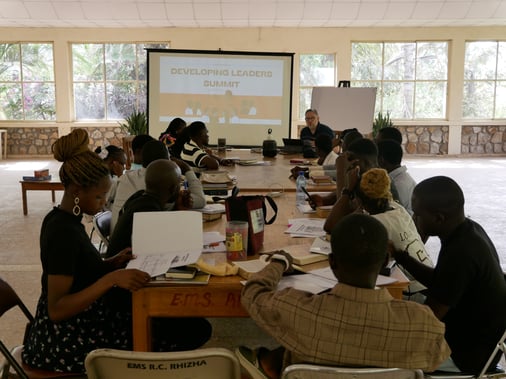
In April, we held two Developing Leaders Summits; one in Ghana and one in Nigeria.
This past April, we led two Developing Leaders Summits, that taught YLI’s holistic discipleship process, which spans a person’s pre-evangelism through growth into a mature, multiplying disciple-maker. For each stage of discipleship, we created case studies for our leaders to implement the PEACE* model approach to discipleship.
P - Prayer
Interceding for disciples and engaging in spiritual warfare
We do our best discipleship when we lead with prayer. Jesus models a life of prayer by constantly going into the quiet places to connect with the Father. Jesus prayed for his disciples, praying specifically for their unity and protection (John 16-17).
Jesus not only modeled prayer but invited his disciples to pray with him. By praying together, the disciples were formed into people who forgave, had a burden for lost and broken people, and were bold to proclaim the Good News.
Prayer often falls to the bottom of our priorities. We cannot cultivate what we do not practice. But as we want to see our disciples grow in their dependence on God, we too must rely on God for wisdom on how to guide our disciples in their walk with God.
E - Encouragement
Strategic connection and modeling Christlike life
Jesus intentionally invited his disciples to get to know him and see his life up close. They went to weddings together, attended synagogues and religious festivals, and shared countless meals. He modeled how to forgive, how to love, and how to be inclusive and break down barriers between people. He invited his disciples to join him, and transformed their calling from fishermen to fishers of men
He identified gifts and granted the disciples spiritual authority. As we walk alongside our disciples, we help them to see their gifts and practice living into their calling. Jesus sent out his disciples in pairs, encouraging them through words of affirmation and prayer (Luke 9 and 10).
Jesus forgave, reconciled, and restored his disciples.
Sometimes the most powerful thing you can demonstrate to your disciple is that you believe in them. I had a mentor in college who constantly said, "I believe in you." This encouragement gave me the courage to be bold in practicing the way of Jesus and stepping out into ministry. Jesus believed in his disciples, and he continues to believe in us. It's important for us to create an environment of encouragement and acceptance for our disciples to have the confidence to step into their calling.
A - Accountability
Make sure there is outward evidence of internal transformation
Help your disciples to take ownership of their faith. Jesus called people to seek the truth, repent, place their trust in God, and be baptized. Jesus challenged his disciples to put their faith in Him and to let go of worldly concerns. Jesus invited his disciples to a change of priorities and a different way of life.
Personal questions and honest answers help others go deeper in their walk with Christ. Teach your disciple how to evaluate their walk with Christ. Ask if they have a burden to share Christ with their non-Christian friends. Notice if they are growing in basic ministry skills and are contributing to a local Christian community. Check in about their commitments and priorities.
A new resource we have been using to teach our leaders how to ask good questions is Fusion's Discipleship Card Deck.
C - Content
Training in biblical truth, theology, and ministry skills
Jesus announced the Kingdom and unfolding the truth of God gradually throughout His ministry. He taught about God's nature and character, sin and humanity's need for a savior, and eternity and divine judgement. He answered people's questions through parables, direct answers, and even more questions. As his disciples grew in understanding, he provided deeper insight and more challenging teachings, like taking up their cross and demonstrating servanthood.
We are always learning!
E - Environment
Allowing the disciple to experience challenging situations for growth
Jesus cultivated various environments for people to encounter Him. His ministry is a mixture of interactions in large groups, smaller gatherings (in homes and in public) and individual interactions for deeper conversation. Some of these environments provided encouragement, while others provided a challenge. Jesus' disciples watched as he taught and witnessed his authority.
Then, Jesus slowly began to give the disciples opportunities to serve and to grow in their commitment. Empowerment leads to personal and spiritual growth. Give away responsibilities in order for your disciple to learn. By stretching your disciple outside of their comfort zone, they learn dependence on God.
These principles are just that - principles. Each disciple is a unique, and has a unique relationship to God. However, these principles can help us as we begin to practice spiritual multiplication and give us a pathway for how to invest in the people that God has placed around us.
*The PEACE model is an adaptation of the R-CAPS Discipleship Model from the Worldwide Discipleship Association